Vushtrri, May ’99: “They tried to kill me, but God did not let me die”
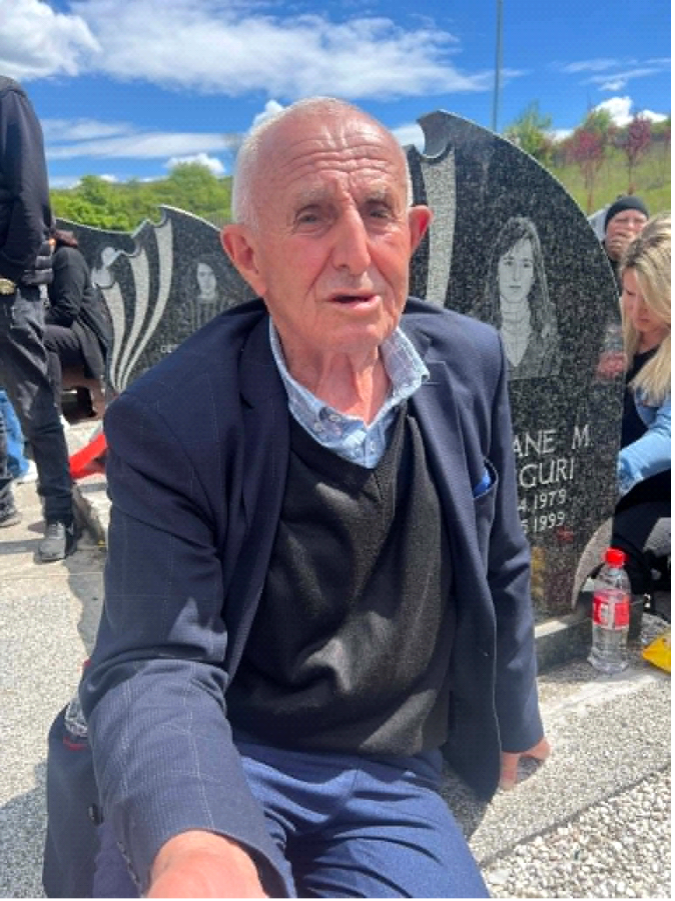
Under the cold marble stone on which he sits are the bones of his sister. In this way, he says, he eases his longing and speaks to her about everyday troubles, with the person with whom he could never share life.
The pain, Musa Gërguri says, is not fading—it is only growing heavier whenever he remembers that all his memories with Hysnije Gërguri are tied to their forced separation by the Serbian army in ’99.
Musa Gërguri, Witness
“I come here often, I sit and talk with my sister Hysnije. She was 30 years old during the war.”
Hysnije was not the only one from the Gërguri family who was massacred in Studime e Epërme. He still remembers the horror of that May evening, even now at 74 years old. Just as fresh in his memory are the gunshots, whose bullets took his loved ones.
“That night they killed my two daughters, Imranë, 19, and Zejnepe, 15, and now also my sister. Only a child’s death was a great pain, ahh, it was very hard. That day my uncle and my uncle’s son were also killed. They killed all those who were the best and most capable. They even killed a deaf-mute neighbor, a good man. They were afraid of him and massacred him,” says Gërguri.
Even 27 years after the war, this event still stays in his mind, and with it the sound of people walking in a column that he cannot remove from his head.
“It was 8 in the evening. We had just set the table and gathered to eat after working all day. It didn’t last long—we heard a gunshot. We went outside and saw that the Serbs had surrounded us. They did not let us speak, they only told us to leave our houses and come out. We did so, leaving the food on the table. In the street there were many people, a column that had come from Shala. They were walking along this road, it was terrifying. The children were frightened, and there the massacre of everyone began. I saw everything with my own eyes, because they also took me to kill me, but God did not let me die and I survived.”He says.
He also remembers the Studime massacre, which took place on 2 May 1999, vividly. Adem Musliu also remembers it, as his son and brother were killed before his eyes.
“I remember the tractor carts filled with women, men, and children, and among them my son and my brother. Along the way, as they were being taken out of the village, my brother told him to hide in a ravine so he could be saved. He went inside. But out of fear from the weapons and the beatings, my brother came out and went to grab him because he was crying. They told him: ‘Pusti je, pusti je’ (Let him go), to release him. He said: ‘No, he is my child.’ And because of those words they shot him in the forehead. Down in the stream they also shot my son Mehdi. It is hard to imagine anything worse, to see it in that condition,” says Adem Musliu, relative of the victims.
Among the line of people who formed long columns was also Ibrahim Gërxhaliu, who at the time was in his house in the Gërxhaliu neighborhood. He says that fate saved him from being killed. The same fate, however, did not save his family members, five of whom were killed, one of them with a bullet to the forehead.
“Before they killed us, they robbed us, stole from us, and beat us wherever they caught us. Fortunately, my children covered me and sat on top of me, so the Serbs did not see me. That night they killed five members of my family: my father, my brother, and three of my uncle’s sons. Those three were killed in front of their parents,” says Ibrahim Gërxhaliu, witness.
Those who survived were loaded onto tractor trailers and taken to Vushtrri, about 10 minutes away from the place where they had experienced the horror.
Upon arriving in the center, residents from all surrounding villages of Studime, from Shala e Bajgorës, Sllakovci, and Cecelia, were dispersed by the regime of the time. Some were sent to the north of the country, while others were sent to Albania.
In this massacre, one of the largest of the last war in Kosovo, 116 Albanians were killed, most of them also mutilated afterward. Among them were children of different ages who never got to enjoy life.
The families of the survivors were told that their tears would dry and their pain would end only when those who committed the crimes and took their loved ones are brought before the justice institutions of the Republic.
To this day, for the 116 murdered civilians, no one has been convicted.